Are Smart Plugs Dangerous to Use with Space Heaters or AC?
The focus is on code-aligned load matching, listed-device selection, and practical failure modes at the receptacle, breaker, and relay level.
Smart plugs are unsafe for most space heaters and many AC units unless the plug, circuit, and load ratings match the appliance’s continuous watts and startup surge, and the device is specifically rated for that use. A mismatch can overheat the plug, trip breakers, or damage the relay and wiring. This guide shows how to read the label, spot surge versus sustained load, and decide when a smart plug is technically compatible versus actually safe. For related guidance, see smart home safety basics and high-wattage appliance control.
Why runtime and surge matter
Yes, if the load is wrong. Space heaters usually draw high wattage for long periods, while air conditioners add compressor startup surge. A smart plug may look fine on the box, yet still be the wrong choice once runtime, surge, and certification are checked together. NEC Article 210.20(A) is the right code lens here because continuous loads must be sized so the branch circuit overcurrent protection is not treated as a 100% continuous-use device. For heater and AC control, that means the branch circuit and breaker matter just as much as the plug body.
Why the answer depends on runtime and surge
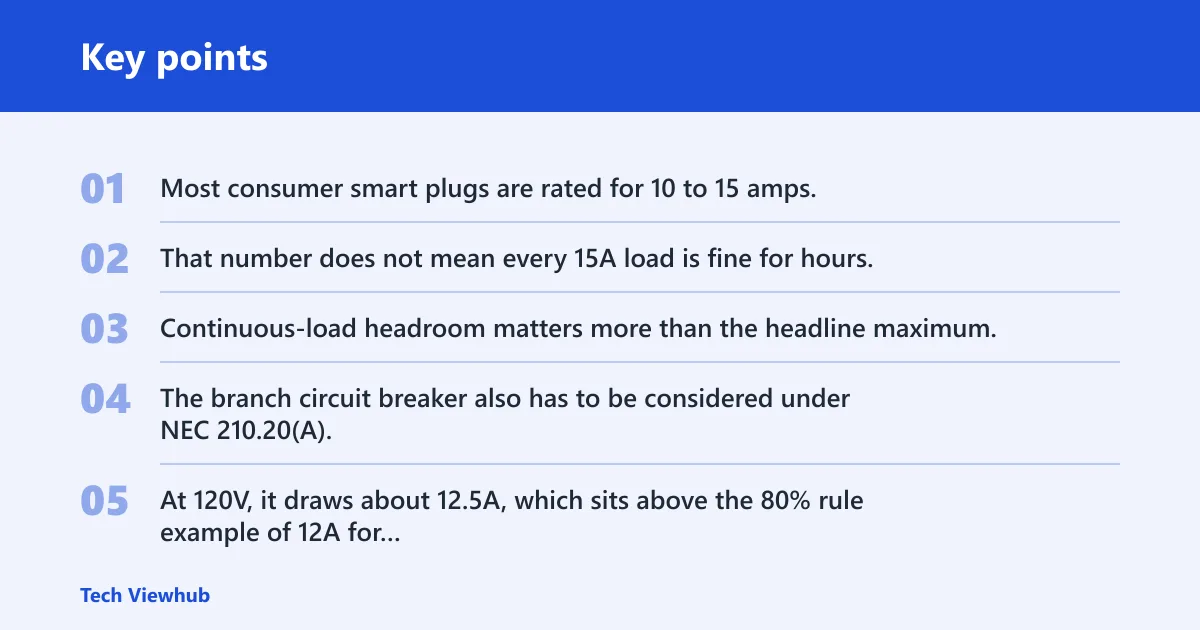
Most consumer smart plugs are rated for 10 to 15 amps, and many 15A models are shown as 120VAC, 60Hz 15A with 1800 watts max on 120V. That number does not mean every 15A load is fine for hours. Continuous-load headroom matters more than the headline maximum, especially for devices that stay on all day. The branch circuit breaker also has to be considered under NEC 210.20(A), not just the plug’s plastic shell or receptacle face.
A 1500W heater is a heavy continuous load. At 120V, it draws about 12.5A, which sits above the 80% rule example of 12A for sustained periods on a 15A plug and branch circuit. An AC unit may draw less while running, but compressor startup can push current higher for a brief period, and that startup surge is where many standard smart plugs struggle. Manufacturer manuals for devices such as Wyze and Kasa also keep the use case narrow: check the specific model’s manual for the stated current limit, supported load type, and any restrictions on heaters or motor loads before assuming compatibility.
Why space heaters are the harder case
Space heaters commonly draw 1000 to 1500 watts of continuous load. That puts them near the upper end of what many consumer smart plugs are built to switch, and the risk is not only breaker trips. Heat buildup inside the plug, loosened outlet contact, and relay wear become more likely when the load stays high for long periods. UL 2043 becomes relevant when the control device is being placed in or near air-handling spaces, because that standard addresses fire characteristics in plenum and air-handling environments rather than simple convenience switching.
Space heaters are resistive loads. They do not have a brief startup spike like a compressor, but they do keep pulling near-full current for the entire run. That long duty cycle is what makes unattended control especially concerning. If a heater is left on and the plug runs hot, the failure mode can be more serious than a simple shutdown.
Suppose a 1500W space heater is set to low in a bedroom and controlled by a Wi-Fi smart plug overnight. Even if the plug is labeled 15A, that does not mean 15A of always-on use is a good idea. The safer reading is about 12A continuous headroom, and heaters above that belong in the caution or do-not-use column. If you are comparing options, a high-wattage appliance control page is the better place to start than a basic smart-plug listing.
Why unattended control is the main concern
Remote on/off is useful, but it also removes a person from the loop. Wi-Fi drops, app failures, schedule glitches, relay wear, and welded contacts can all leave a heater or AC in the wrong state. If a space heater is involved, the risk multiplies because the appliance keeps generating heat even when the control path is failing.
That is why most smart plug articles advise against space heaters. The issue is not only wattage. It is the mix of sustained heat, high current, and no supervision.
Can I use a smart plug with a window air conditioner?
Sometimes, but only after you check the appliance label, the smart plug label, and the startup behavior. A small window AC may work with a properly rated, certified smart plug if the running draw stays within limits and the plug is designed for motor loads. The running wattage alone is not enough to decide.
Running wattage versus compressor startup surge
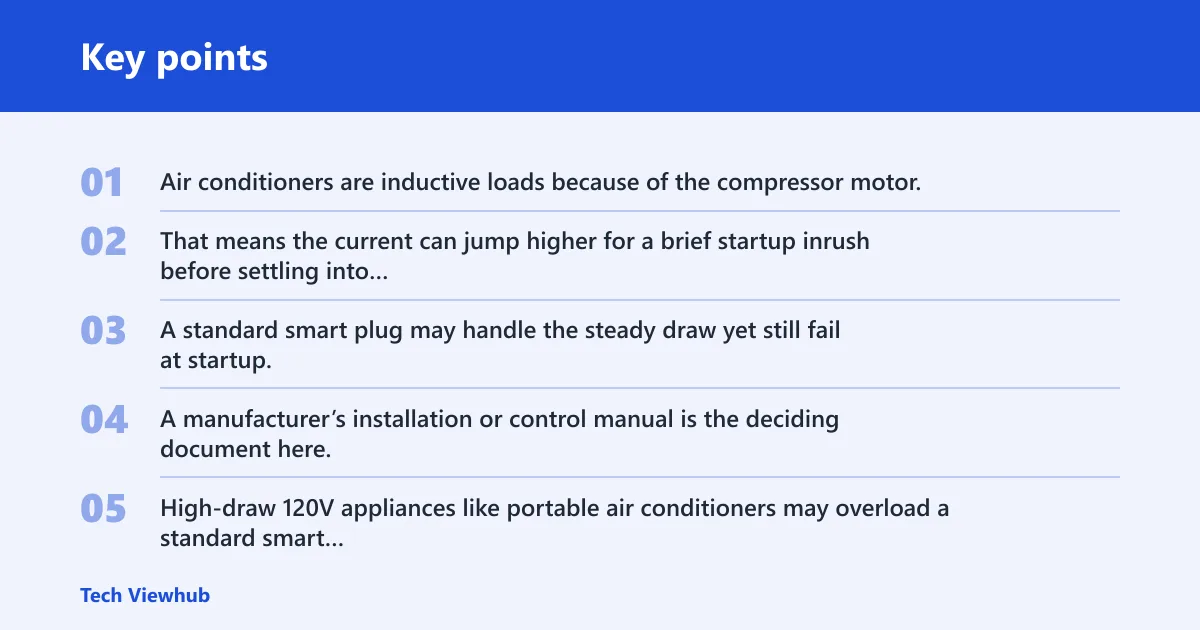
Air conditioners are inductive loads because of the compressor motor. That means the current can jump higher for a brief startup inrush before settling into normal operation. A standard smart plug may handle the steady draw yet still fail at startup, or may overheat if the relay is not built for that type of switching. A manufacturer’s installation or control manual is the deciding document here; if the model does not explicitly permit external power switching or compatible smart control, treat it as unsupported.
High-draw 120V appliances like portable air conditioners may overload a standard smart plug. Window units vary more widely, and the label should be checked model by model. If the manual or nameplate does not state a startup profile or compatible external control method, treat the setup as caution at best.
Window AC versus portable AC differences
Window AC units often have simpler power behavior than portable units, but that is not a blanket pass. Some have lower steady draw and a clearer on/off state; others cycle hard enough that a small smart plug is still a poor fit. Portable AC units are more likely to stress a standard consumer plug because of draw and startup behavior.
Purpose-built controls are better here. If the AC has built-in Wi-Fi, an official remote control path, or a manufacturer-approved smart thermostat interface, use that first. A smart plug should be a secondary option only when the appliance label and the plug label both support it.
When a model is still a no-go
Do not use a smart plug if the AC’s rated draw is near the plug’s continuous limit, if the startup surge is unknown, or if the plug is not listed for that load type. Also avoid setups that require an extension cord or power strip in the chain. If the circuit, receptacle, and plug do not all fit the load, the answer is no.
Smart plug decision matrix
This table separates technically compatible from actually safe. Use the appliance type, rated wattage, amp draw, startup surge, runtime, and certification together. A listed product can still be the wrong choice if the load is continuous, motor-driven, or unattended.
| Appliance type | Rated wattage | Amp draw | Startup surge | Runtime | Required certification | Outcome |
|---|---|---|---|---|---|---|
| 1500W space heater | 1500W | About 12.5A at 120V | Low startup surge, but steady resistive draw | Hours | UL, ETL, or other NRTL listing on plug and outlet-side device | Do not use for unattended control; caution only for brief, supervised checks |
| 1000W space heater | 1000W | About 8.3A at 120V | Low startup surge | Short supervised use | UL, ETL, or other NRTL listing | Caution; only if the plug stays well under continuous headroom and the maker allows it |
| Small window AC | Varies by model | Varies by model | Possible compressor inrush | Hours | UL, ETL, or other NRTL listing; check appliance manual for external control compatibility | Caution if the running draw and surge are clearly within limits; otherwise do not use |
| Portable AC | Varies by model | Often high for 120V | Higher likelihood of surge stress | Hours | UL, ETL, or other NRTL listing plus manufacturer-approved control method | Do not use on a standard smart plug unless the device is explicitly approved for that load |
Worked example: 1500W heater
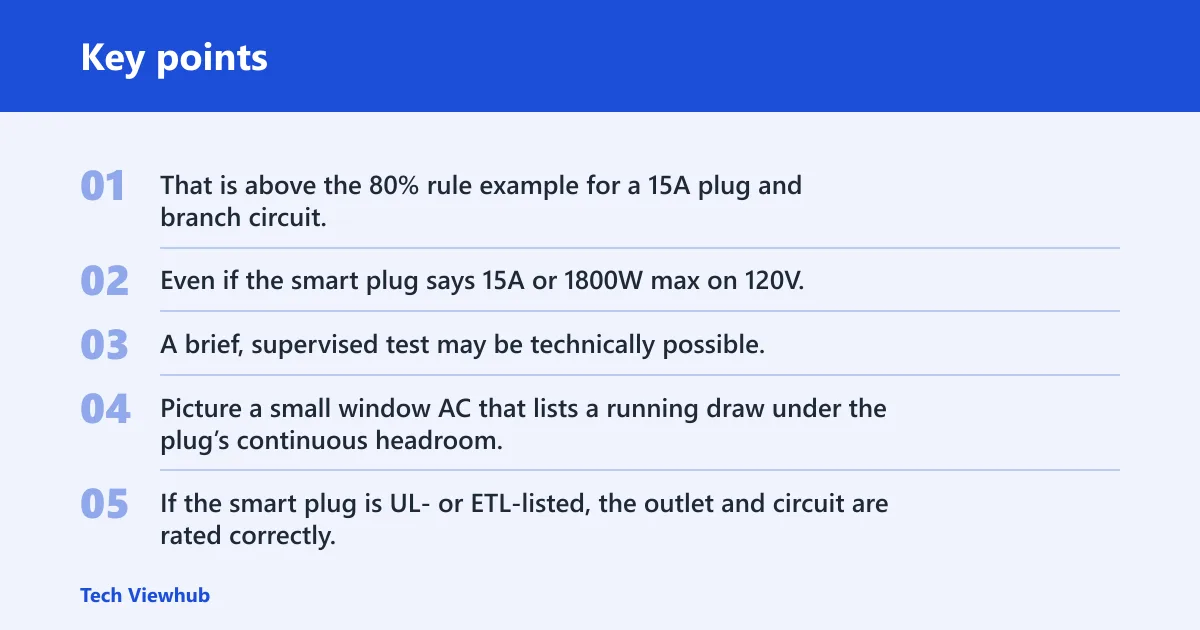
That is above the 80% rule example for a 15A plug and branch circuit, which is about 12A for sustained periods. A brief, supervised test may be technically possible, but that is not the same as safe long-run automation.
Worked example: small window AC
Picture a small window AC that lists a running draw under the plug’s continuous headroom, with a known startup surge that the manufacturer says is acceptable for external switching. If the smart plug is UL- or ETL-listed, the outlet and circuit are rated correctly, and the appliance manual allows this control method, the answer can move from do not use to caution. If the surge is unknown, stay with a built-in control.
How to read the labels side by side
Read the appliance label, the smart plug label, and the circuit rating together. The right comparison is not appliance versus plug alone. It is appliance load, plug limit, and outlet-circuit capacity side by side, with the 80% rule applied to continuous use.
- Find the appliance nameplate wattage or amp draw.
- Check whether the load is resistive, like a heater, or inductive, like a compressor.
- Read the smart plug label for amps, volts, watts, and any motor-load notes.
- Look for UL, ETL, or another NRTL mark on the plug and, when possible, the appliance-control device.
- Check the outlet and branch circuit rating before adding a long-run load.
- Apply the 80% rule to the plug’s continuous use, not just the peak label.
- Reject any setup that needs an extension cord or power strip in between.
What the 80% rule means here
The 80% rule says a 15A plug should not exceed 12A for sustained periods. For accuracy, that guideline is not just about the plug body; it applies to the branch circuit and breaker as well when the load is continuous. NEC Article 210.20(A) is the code reference commonly used to justify sizing branch-circuit overcurrent protection at 125% of continuous load, which is why a 15A setup is not treated as a full 15A continuous-use solution. That matters most for long-runtime devices like heaters, but it also helps with AC units that cycle often.
Continuous load is different from startup load. Continuous load is what the appliance pulls while running. Startup load is the brief inrush that happens when a motor or compressor starts. A heater stresses the plug by staying near full draw; an AC stresses it by adding surge on top of runtime.
What can fail before the breaker trips?
The breaker is not the first thing that fails. Smart plugs can heat up, relays can wear out, contacts can loosen, and the plug body can run warmer over time long before a breaker opens. That is why a setup can look electrically “within rating” and still be a poor choice for heat-producing appliances.
Relay wear and welded contacts
Repeated switching under heavy load can wear the relay. In worse cases, contacts can weld closed, leaving the appliance powered when it should be off. That failure matters most with heaters, where unwanted runtime means unwanted heat.
Loosened outlet contact and heat buildup
A loose receptacle grip increases resistance at the plug blades. More resistance means more heat at the connection point, which can build over hours. A standard consumer smart plug used near its limit may expose that weakness faster than a simple lamp would.
Wi-Fi, app, and schedule failure modes
Automation can fail in software as well as hardware. A Wi-Fi drop may block a scheduled shutoff, an app outage may prevent a manual command, and a mis-set routine may turn a heater back on at the wrong time. For heaters, that is why unattended control is the line most people should not cross.
A common first-timer mistake is to focus only on the plug’s maximum wattage and ignore runtime. A 1500W heater and a 1500W kettle are not the same job. One runs for minutes. The other may run for hours, and hours are where heat accumulation and contact wear matter most.
Expert Verification
Licensed electrician commentary on relay wear is consistent across field cases: inductive loads such as compressor motors are harder on relay contacts than simple resistive heaters because the switch opens and closes against higher arcing stress. That is why a smart plug that looks adequate on paper can still fail early when used with AC equipment, even if the steady-state current seems acceptable. The practical takeaway is to treat motor loads as a relay-life problem as much as an amp-rating problem.
Electrical verification also comes back to standards, not only product marketing. UL 2043 is relevant where the device may be installed in air-handling spaces, and NEC 210.20(A) remains the branch-circuit sizing check for continuous loads. Manufacturer manuals from companies such as Wyze and Kasa should be read as the final authority for supported load type, maximum current, and any prohibition on heaters or compressor loads.
Safer alternatives for heaters and AC
For heaters, built-in thermostat control is usually better than an external smart plug. For AC, built-in Wi-Fi control or a manufacturer-approved smart thermostat is the safer path when available. If the appliance needs external switching, choose a heavy-duty device that is explicitly rated for that load and control type.
Built-in Wi-Fi control
If the appliance already has network control, use that first. It keeps the switching design inside the product the maker intended, which reduces the guesswork around surge, relay sizing, and load compatibility. That matters especially for portable AC units.
Smart thermostats and purpose-built controls
A smart thermostat is a better fit for whole-room or whole-system heating and cooling. It is built to manage temperature cycles rather than simply cut power. For space heaters, a thermostat-controlled appliance is usually a better answer than a plug-based on/off schedule.
When a heavy-duty device may be appropriate
Some heavy-duty controls are built for higher current, motor loads, or hardwired HVAC equipment. Those are not the same as a standard consumer smart plug. If the device is intended for heaters or compressors, the listing and manual should say so plainly.
Frequently asked questions
Are smart plugs safe to use with space heaters?
Usually no, especially for a 1500W heater running for hours. If the heater is unattended, the answer should be no unless the control device is specifically rated and approved for that use.
What smart plug wattage do I need for a heater?
For a heater, the better question is continuous current headroom, not just wattage. A 1500W heater sits above that, so the label math still points away from smart plug control.
Why are space heaters risky on smart plugs?
They are risky because they combine high continuous draw with long runtime. That can heat the plug, loosen contacts, and wear the relay. The heater itself also keeps producing heat if automation fails, so a Wi-Fi or app problem can become a safety problem instead of a convenience issue.
Do smart plugs handle AC compressor startup surge?
Some can, but many standard consumer plugs are not a good match unless the maker says they are suitable for motor loads. Compressor startup surge can exceed the steady running draw by enough to trip or stress the plug. Check the model’s manual and certification before treating it as compatible.
What appliances should never go on a smart plug?
Any appliance that exceeds the plug’s continuous rating, needs startup surge headroom beyond the label, or must never be left unsupervised should stay off a standard smart plug. That includes most space heaters, many portable AC units, and anything that requires an extension cord or power strip in the chain.